
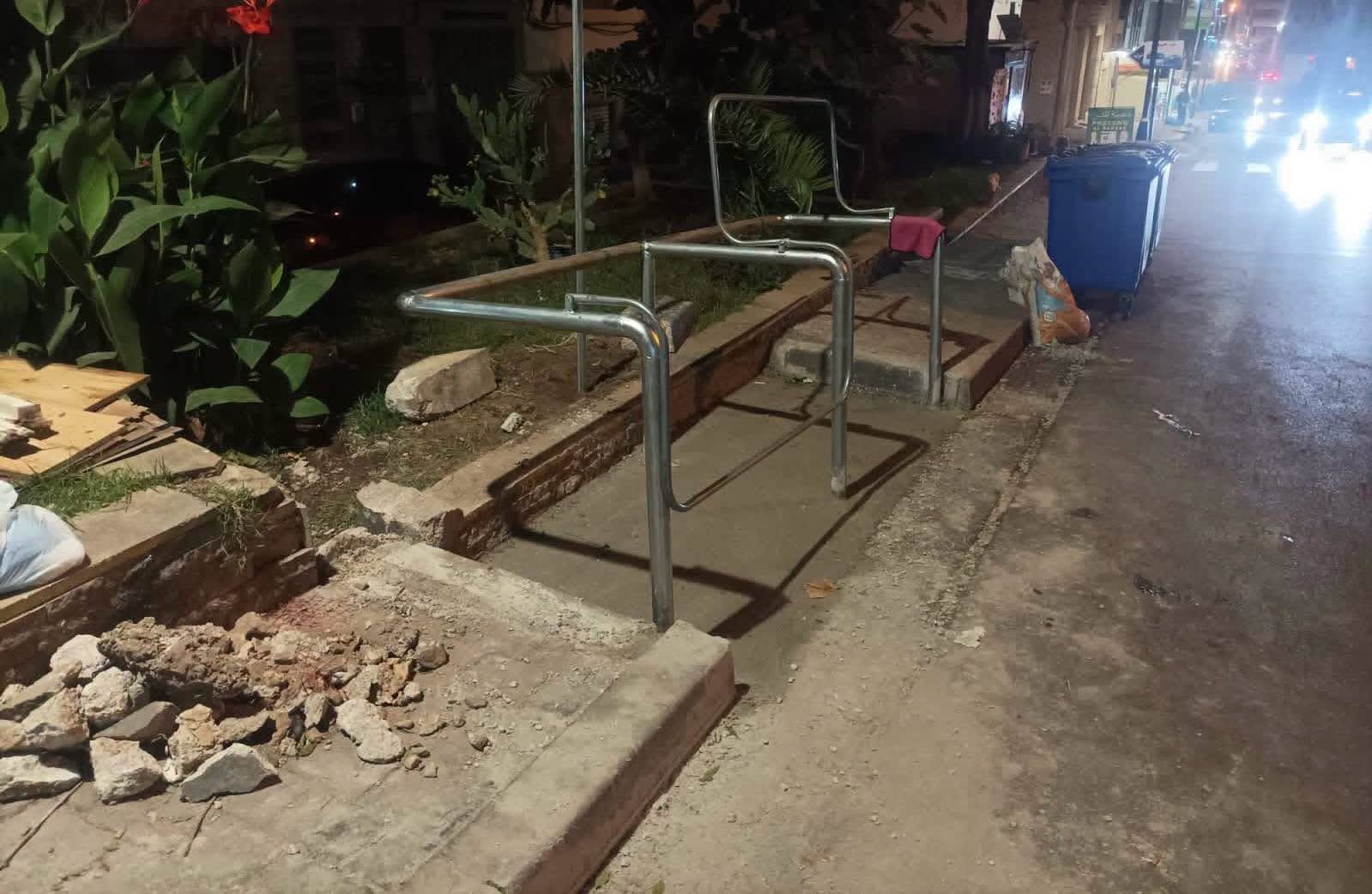
Widespread anger as sidewalk sections are removed in Al Hoceima to place rubbish bins at the expense of pedestrian safety
The way rubbish bins are being installed in several streets and neighbourhoods of Al Hoceima has triggered a wave of criticism and discontent among residents, after it was noticed that sections of sidewalk meant for pedestrians had been removed or significantly reduced to make room for the bins, blocking pedestrian movement and forcing people to walk on the road reserved for vehicles.
Many residents say this approach reflects poor urban planning: it would have been possible to look for more effective solutions that preserve pedestrians' right to use the sidewalk, instead of removing part of it or eliminating it entirely to place bins. The sidewalk is not just a strip of concrete, they recall, but an essential public asset that guarantees safety for everyone, especially children, the elderly and people with disabilities.
In several parts of the city, sidewalks have become unusable, fully or almost fully occupied by bins. In some spots there is not even enough room for one person to pass, forcing pedestrians to step straight onto the road and increasing the risk of accidents, especially on busy streets.
The situation is even worse for people with disabilities who use wheelchairs, as passage often becomes impossible. Parents pushing strollers face the same problem and have to share the road with cars, putting themselves and their children at real risk.
Urban planning experts point out that modern cities follow the principle of "pedestrian priority", widening sidewalks and improving accessibility — not the opposite. Many cities remove obstacles from sidewalks and assign dedicated spaces for bins without affecting citizens' right to move safely.
Residents wonder why this solution was chosen when many alternatives existed: rearranging bin locations, using side spaces, or designing dedicated spots that do not affect pedestrian movement. Removing part of the sidewalk, they warn, is an easy fix that does not solve the underlying problem and creates new daily issues.
In several Al Hoceima neighbourhoods, sidewalks were already narrow before these changes, which makes any further reduction particularly serious. Sidewalks have lost their basic function, and walking on them has become difficult or impossible in many places.
Accessibility specialists stress that the design of public spaces must take into account the needs of everyone, including people with special needs, the elderly and children. The right to move safely and independently is a basic principle that any project affecting public space should respect.
Residents fear that continuing along this path will worsen safety problems in the city, with growing numbers of cars and motorbikes that make the pedestrian the weakest link. Sidewalks, they insist, were built to protect people, not to store bins.
Local observers note that waste management should not come at the cost of citizen infrastructure. Any successful urban hygiene project must balance an efficient waste collection service with preserving the quality and usability of public space.
Several residents call on the municipal council to review these choices and carry out a field study at the points where sidewalks have been removed or reduced, with participation from residents and local associations. They also call for rehabilitating damaged sidewalks and providing safe passages that meet accessibility standards for people with disabilities and strollers.
Improving the image of the city, they conclude, is not only about new bins or organised collection: it also means respecting pedestrians' right to move through safe and comfortable spaces. The open question remains: is it reasonable for the sidewalk — originally built to protect pedestrians — to be turned into a mere support for rubbish bins?